Rennes court-martial
An Officer and a SpyThe Rennes court-martial was the military tribunal that retried Alfred Dreyfus in 1899. Its proceedings reopened the treason case before the public, but soon placed decisive material beyond public scrutiny: after an initial public hearing, the judges considered secret files in closed session. The court returned a guilty verdict by five votes to two and reduced the sentence to ten years’ imprisonment. That compromise neither resolved the case nor restored Dreyfus’s name; the verdict was eventually quashed, and Dreyfus was fully exonerated in 1906.
Composition and Opening
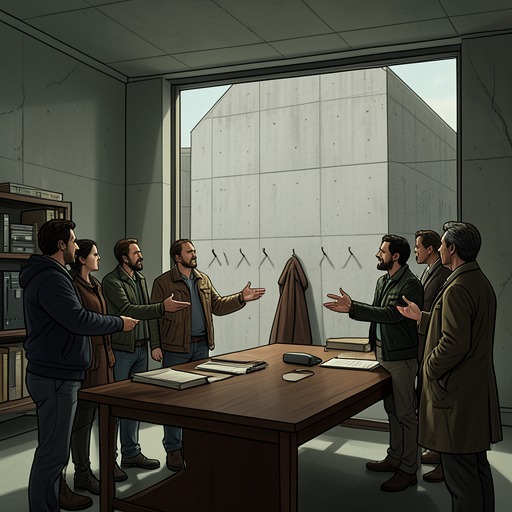
The account presents the court as a military tribunal led by Colonel Jouaust. Its opening session assembled the judges, lawyers, accused, and observers in a courtroom where military discipline remained conspicuous: a command to present arms preceded the judges’ entrance, and Alfred Dreyfus was brought in under escort. By then, he appeared physically diminished after years away from France, moving stiffly and laboriously to his place. His changed appearance made the cost of the earlier conviction visible before the new proceedings had tested its evidence.
The opening was public, but its openness was immediately contested. Prosecutor Brisset asked for a private hearing on the ground that the case involved national defence. Edgar Demange objected that his client was entitled to treatment like any other accused person. The dispute set out a central tension in the tribunal’s work: the case required evidence to be examined, yet military claims of secrecy could restrict who was permitted to see and hear that examination.
Proceedings and Evidence
Jouaust formally stated the accusation and presented Alfred Dreyfus with the bordereau, the memorandum used to specify the documents he was alleged to have delivered to a foreign agent. Dreyfus studied it and again declared his innocence, invoking the honour of his name and his children. For the remainder of the morning, Jouaust questioned him item by item about its contents. Dreyfus answered in a dry, technical manner, denying, among other allegations, that he had sought information about artillery, troop movements, or plans concerning Madagascar. He also denied ever saying that France would be better off under German rule.
The court’s treatment of secrecy shaped the next stage. At the end of that morning, Jouaust announced that the following four days of hearings would take place behind closed doors so that the judges could be shown the secret files. The public and press were excluded, as was Georges Picquart, who would have to wait at least a week before being called to give evidence. The procedure therefore separated the judges’ access to secret material from the public’s ability to scrutinize it, even as the case depended on disputed claims about what the documents proved.
When Auguste Mercier gave evidence, he spoke for three hours and produced document after document from a black leather case. Among them were the so-called lowlife D letter, which he continued to interpret as referring to Dreyfus, and fabricated Guénée reports about a spy in the intelligence department. Mercier omitted the name of the reports’ source, Val Carlos. His presentation brought evidence associated with the secret dossier into open court, exposing material that Fernand Labori could challenge in cross-examination. The testimony thus revealed a contradiction in the conduct of the case: information previously shielded as secret was now being advanced publicly to sustain the accusation.
Verdict and Consequences
After the judges deliberated for an hour and a half, the result was communicated as guilty by five votes to two, with the sentence reduced to ten years’ imprisonment. The reduced term did not amount to acquittal. The court had again condemned a man who maintained his innocence, and its decision left the underlying dispute unresolved. The verdict became another stage in the prolonged struggle over whether the evidence against Dreyfus could withstand examination, rather than the final word on his guilt.
The court’s proceedings also belonged to a larger sequence of military judgments and public ceremonies. In 1894, the first court-martial had sentenced Dreyfus to deportation for life and discharge from the army; the sentence was followed by a public degradation ceremony at the École Militaire, where he was stripped of his rank before soldiers and spectators. The Rennes court was a separate tribunal, convened years later to retry the case, but it could not escape the institutional legacy of that first conviction. Its own verdict prolonged the consequences of the earlier judgment before later judicial review finally reversed them.
Reversal and Institutional Significance
The Rennes verdict was overturned on 12 July 1906, when the Supreme Court of Appeal quashed it and fully exonerated Dreyfus. The following day, the Chamber of Deputies voted to restore Dreyfus to the army as a major and award him the cross of the Legion of Honour, by 432 votes to 32. A separate motion restored Picquart to the rank he might have attained had he not been dishonourably discharged in 1898; it passed by 449 votes to 26. Picquart then returned to the parade ground at the École Militaire for Dreyfus’s medal ceremony, now in the uniform of a brigadier general.
In that sequence, the Rennes court-martial marks both the persistence and the eventual reversibility of military judgment. Its closed hearings gave the judges access to secret files while excluding the public and Picquart; its verdict renewed the conviction without ending the controversy. The later reversal and restoration ceremonies supplied a public counter-image to the degradation of 1895. They could not undo the years lost, but they established that the Rennes judgment was not the case’s final legal or institutional conclusion.